
As a US federal agent and diplomat, Jeremy Miles investigates human trafficking in Brazil and spent a week visiting the Pink Houses. Here he recalls what he saw and heard…
I came across Meninadança while researching human trafficking in Brazil. With a background in US federal law enforcement, I’ve spent years investigating international trafficking and working with partners to prevent exploitation.
I’ve seen trafficking cases in various forms. Still, nothing prepared me for the week I spent traveling Brazil’s BR-116 highway with Meninadança, visiting the Pink Houses that welcome and protect girls at risk of exploitation.
As an investigator, I’m always looking for credible, effective partners on the front lines of human trafficking. Meninadança quickly stood out. They aren’t just rescuing girls from exploitation – they help them heal and pursue justice.
My team connected with Meninadança because we saw an organisation deeply embedded in vulnerable communities, and respected by law enforcement, prosecutors, and social services. They live and work where exploitation happens, changing lives and communities every day.
Our first meetings with Meninadança confirmed what I suspected: this was the real deal. At their office in Belo Horizonte, I met Warlei and the team and joined a virtual conference with Pink House coordinators and lawyers. They described the realities they face and the courage of the girls they serve.
Soon after, we hosted Meninadança at the U.S. Embassy in Brasília, where they presented their work to my colleagues. Then, we set off together on a week-long journey up the BR-116 highway to see firsthand what life looks like along Brazil’s most notorious child sex trafficking route.
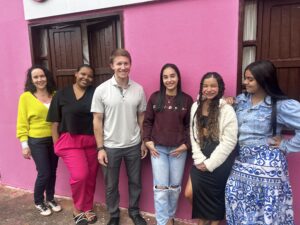
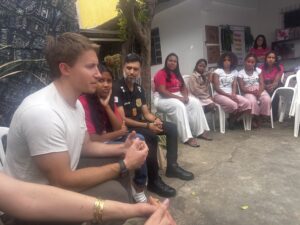
In Padre Paraíso, after dances and group activities, we gathered in a conversation circle to hear 15-year-old Dany’s* story. She told us about years of sexual abuse, poverty that left her family hungry with nothing but dry flour to eat, and violence that claimed her aunt’s life. Yet what struck me most was not her suffering, but her resilience. The whole room was in tears as she described what she’d overcome and then shyly admitted that she wanted to be a psychologist or a lawyer – so she could help other girls like the professionals who had helped her.
When asked what Meninadança meant to her, Dany didn’t hesitate: “Meninadança is life!”
“What do you mean, it’s life?” someone asked.
“It’s life! It’s everything!” she replied.
Through Meninadança, Dany is receiving medical and psychological care. She’s studying, working part-time at a restaurant, and pursuing justice through a complaint filed against her abuser. It is still winding its way through Brazil’s painfully slow judicial system, but in the meantime, Meninadança helped secure a protective order to keep him away.
We also heard from Maria, the mother of a Pink House girl. Her story was different, but no less heartbreaking. Abandoned at age two, she endured a childhood filled with physical, psychological, and sexual abuse. Now 29, she is a single mother of three, determined to protect her daughter and break the cycle of exploitation.
Yet it hasn’t been easy. One of Maria’s children has severe autism and is entitled to government benefits. However, she was no longer able to afford the child’s medication and couldn’t receive the government benefits until after a specialized evaluation. But she’d been waiting more than seven months for the evaluation through the public health system. She admitted through tears that, without support, she had resorted to prostituting herself to feed her children.
After our meeting, I watched the Pink House staff and attorneys quietly confer. They made plans to help the family with food, medication, and access to a private autism specialist. That’s how Meninadança works – they understand that protecting the girls often means helping the whole family.
Further up the highway in Cândido Sales, the presence of criminal gangs was palpable. That feeling only grew stronger as we talked to the staff and girls about the threat the groups posed to the girls and the town. Luiza, 14, described her abuse and exploitation, which she only escaped after the murder of her friend at the hands of a gang. Then, a mother with nine children told us how the Pink House had carried her family through years of hardship – with staff even spending from their own salaries to provide groceries – and how she couldn’t imagine life for her family without the Pink House.
This is the reality: girls caught in poverty and organised crime, families struggling to survive, and communities overshadowed by violence. Yet Meninadança is there, standing with them.
The local police chief, Alexandre, joined our conversation circle at the Pink House in Medina – a time filled with tears and laughs as the girls and staff described past run-ins with the law. Alexandre responded simply: “It’s all forgotten now.”
One testimony that struck me was Bia’s, whose story I had first encountered in Before the Night Comes. Now part of the Pink House staff, she was a symbol of hope and a role model for the girls there. Afterwards, the girls laughed, asked for photos, and teased: “We want pictures, you’re famous!” (I think they mistook me for Canadian singer Dean Brody!)
Moments like these showed me how Meninadança doesn’t just transform girls’ lives, it reshapes community relationships, bridging survivors, families, communities, and police.
During a roundtable with staff, social services, and town hall officials at the Pink House in Catuji, I asked what they needed to be more effective. I expected them to say more money, more staff, more resources. Instead, they agreed: “We need prosecutors to act.”
That refrain echoed throughout the week. The justice system’s failure to hold abusers accountable was one of the most significant barriers to prevention, protection, and recovery. As a law enforcement officer, I know how critical prosecution is for real accountability.
And I saw Meninadança’s lawyers stepping into that gap, guiding girls through the legal system, helping gather evidence, and pushing cases forward. Without them, many abusers would never be held accountable.
By the end of the week, I was exhausted – and changed. The suffering was immense, but so was the resilience, the joy, and the hope. I am comforted knowing there are people who care, helping one girl at a time, and that one day, He will wipe every tear from their eyes.
Dean Brody’s song Leilah, about a young girl selling herself on the side of BR-116, has a line: “The world has forgotten you, but I know that I never will.” Meninadança makes sure the girls are not forgotten. I know I never will.
Subscribe
To our newsletter